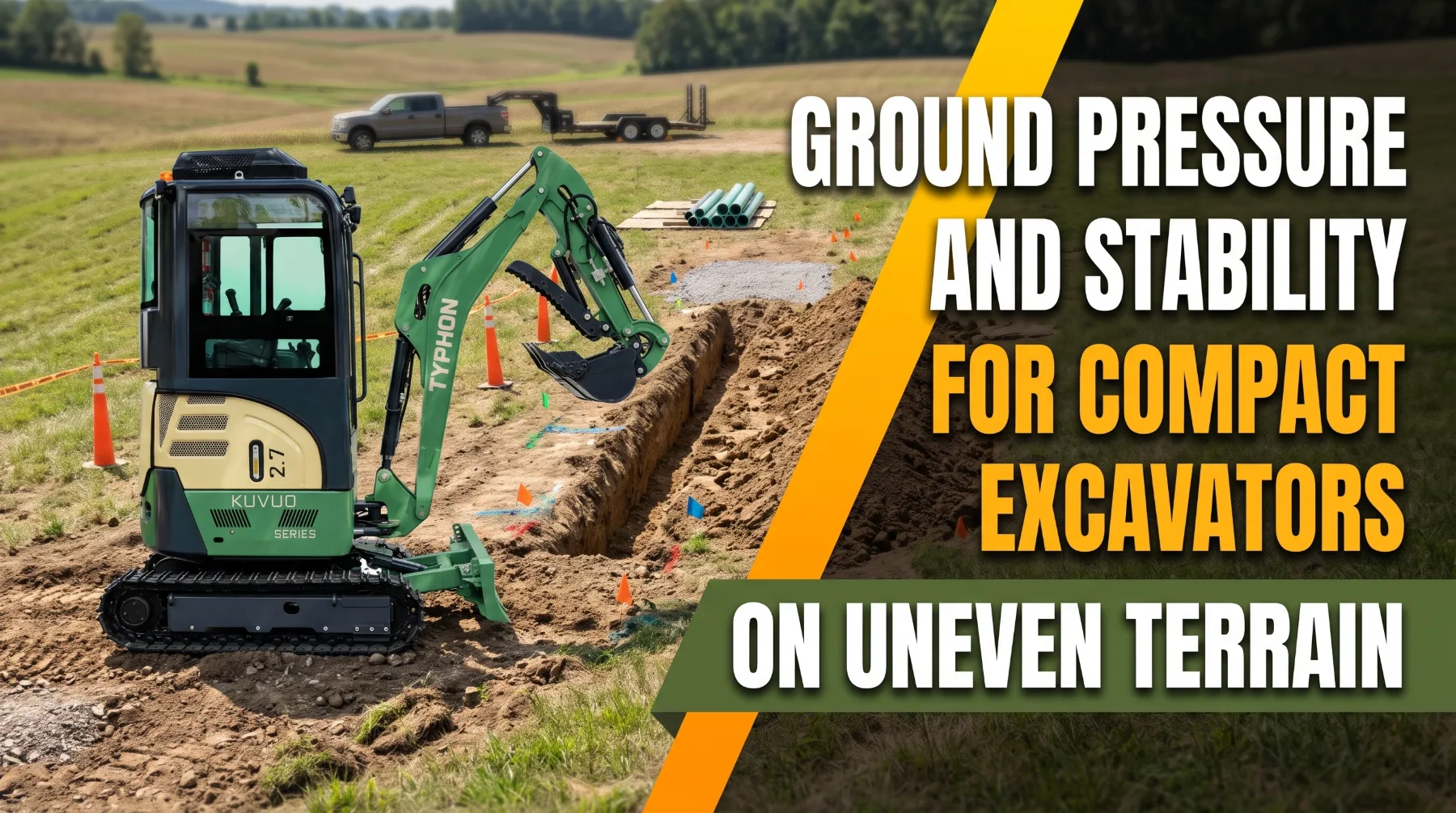
A utility contractor is installing a new water service line on a sloped rural lot. The trench route runs along a hillside where recent rain has softened the ground and an old buried stump has left a hidden void beneath the topsoil. The operator positions the compact excavator across the slope to dig parallel to the grade. He swings a loaded bucket toward the downhill spoil pile. As the boom reaches outward, the downhill track settles into the soft patch and the machine leans noticeably toward the slope. The operator stops, lowers the bucket to the ground, and the excavator settles back onto both tracks. No one is hurt and nothing is damaged. After lunch, the crew cuts a level bench into the hillside and fills the void with compacted stone. The operator repositions the machine with its tracks pointing up the slope and the blade lowered on the downhill side. The trench is finished by the end of the day with no further problems. The machine never changed. The setup did.
Compact excavators regularly work on slopes, loose soil, partially prepared surfaces, and uneven construction ground. Under these conditions, ground pressure and machine stability directly influence digging performance, travel, and operator safety. Ground pressure describes how the machine's weight spreads across its supporting surface. Stability describes the machine's ability to stay balanced as it digs, swings, lifts, and travels. Stability depends on track contact, center of gravity, boom position, load, and the strength of the ground beneath the tracks.
These two concepts are closely related, but they aren't interchangeable. A machine with low ground pressure may cross soft ground without sinking and still tip if the boom swings a heavy load over the downhill side. A stable machine on firm ground may still rut or sink when it moves onto saturated soil. Understanding both helps operators plan excavation work, position the machine correctly, and avoid conditions that lead to sliding, tipping, or excessive ground disturbance. The manufacturer's operator's manual, lifting charts, slope limits, and applicable regulations remain the primary reference for every machine and procedure.
Track Contact Area and Weight Distribution
Track dimensions determine how a compact excavator's weight spreads across the ground. Ground pressure is calculated by dividing the machine's weight by the area of track in contact with the surface. A larger contact area spreads the same weight across more ground, which reduces average pressure. Wider track shoes or longer track frames can therefore help the machine travel and work on softer surfaces with less sinking and rutting. Manufacturers often offer track options, and the choice between rubber and steel tracks or different shoe widths affects both ground pressure and traction.
Average ground pressure is a useful comparison figure, but actual pressure beneath the tracks is rarely uniform. As the operator digs, swings, and lifts, the weight shifts toward the front, rear, or one side of the undercarriage. A loaded bucket held far out in front pushes more weight onto the front of the tracks. Swinging toward one side loads that side's track more heavily. Attachments, counterweight, the cab or canopy configuration, and even a full fuel tank all add to the total weight the tracks must carry.
Low ground pressure helps protect lawns, finished surfaces, and soft soil, but it doesn't guarantee stability. A wide track can still sink into saturated ground, and a light, low-pressure machine can still tip if its load is poorly positioned. Buyers should compare ground pressure alongside operating weight, track width, track length, and the machine's stability characteristics. Operators should treat published ground pressure as a starting point, then judge the actual ground and loading conditions on every job.
Key takeaway: A larger track contact area lowers average ground pressure, but weight shifts constantly during digging and swinging, so evaluate track configuration, machine weight, and ground strength together rather than relying on a single published figure.
Center of Gravity During Excavation
Every compact excavator has a center of gravity that moves as the machine works. When the boom, arm, and bucket are tucked close to the machine, the center of gravity sits low and near the middle of the undercarriage. As the operator extends the attachment, raises the boom, or fills the bucket, that point moves outward and upward. The machine stays stable only while its combined center of gravity remains inside the area supported by the tracks.
The upper structure adds another variable. On a compact excavator, the cab, engine, counterweight, and boom all rotate as one unit. Swinging the upper structure changes the direction in which the machine's weight acts. A compact excavator is usually more stable when working over the front or rear of the tracks, where the support base is longest, than when working over the side, where the base is narrowest. Reduced-tail-swing and zero-tail-swing models trade some counterweight overhang for compact operation, which makes attachment position and load handling even more important.
Operator technique keeps the center of gravity under control. Keep loads within the manufacturer's limits, carry the bucket low, and swing smoothly rather than abruptly. Sudden stops at the end of a swing or a quick drop of a loaded bucket create dynamic forces that can momentarily push the center of gravity toward the edge of the support area. Operators should wear the seat belt at all times, since the protective structure protects the operator only when the operator stays inside it.
Key takeaway: Extending, raising, loading, and swinging the attachment all move the center of gravity outward and upward, so keep loads within limits, work over the ends of the tracks when possible, and swing smoothly to protect the stability margin.
Uneven Ground and Track Support
Stable operation depends on both tracks resting firmly and evenly on the ground. When one track sits higher than the other, or when part of a track spans a dip, rut, rock, or stump, the machine has uneven support. The upper structure tilts, the center of gravity shifts toward the low side, and the stability margin shrinks before digging even begins. Uneven support can also affect digging alignment, making it harder to cut a straight, level trench or grade.
Hidden ground conditions create some of the greatest risks. Soft backfill, buried voids, old excavations, decayed roots, and saturated soil can look solid on the surface and give way under a loaded track. Freshly placed fill may compress as the machine works. Edges of trenches and excavations can collapse under the weight of a track positioned too close. Operators should walk the work area before positioning the machine, probe suspicious areas, and keep tracks well back from excavation edges.
When conditions aren't suitable, the right response is to prepare the ground rather than work around the problem. Remove high spots and obstacles, fill and compact low areas, and create a firm, level working pad where the machine will dig. Avoid positioning the excavator across severe irregularities such as large rocks, curbs, or ruts. If the work area can't be made stable, choose a different position or approach.
Key takeaway: Both tracks need firm, even support, so walk the area, identify soft spots, voids, and edges, and prepare a level working pad rather than positioning the machine across irregular ground.
Slope Direction and Machine Positioning

Slope direction has a major effect on compact excavator stability. Traveling straight up or down a slope keeps the machine's longest support base aligned with the grade, which generally provides the greatest resistance to tipping. Working or traveling across a slope places the narrow side of the undercarriage downhill, where the stability margin is smallest. Swinging a loaded bucket toward the downhill side on a side slope combines several risks at once.
Correct positioning reduces those risks. Whenever possible, cut a level bench into the slope so the machine works on flat ground. When traveling on a grade, keep the bucket low and close to the ground, travel slowly, and avoid sudden steering or speed changes. Many manufacturers recommend specific orientations for the blade and drive sprockets on slopes, such as keeping the blade on the downhill side so it can be lowered for support. Follow the procedures in the operator's manual for the exact machine.
Slope limits apply to every compact excavator, and operators must follow them. A machine's ability to climb a slope doesn't mean it can safely dig, lift, or swing on that slope. Soil condition, moisture, attachment position, and load all reduce the safe operating range. Wet clay, loose gravel, and grass can cause the tracks to slide even on grades that feel manageable. When in doubt, reduce the slope, reposition the machine, or change the work method.
Key takeaway: Travel and work straight up and down slopes rather than across them, bench the slope where possible, follow the manufacturer's slope limits, and never assume a slope is safe for digging just because the machine can climb it.
Bucket Loads and Lifting Leverage
A loaded bucket at the end of the arm creates leverage that acts against the machine's stability. The farther the load sits from the machine, the greater its tipping effect. A modest load held close to the tracks may be easy to manage, while the same load at full reach can approach the limit of the machine's stability. Material weight adds to the effect, since wet soil, clay, rock, and broken concrete weigh far more than dry topsoil for the same bucket volume.
Lifting objects introduces additional considerations. Compact excavators used for lifting pipe, structures, or other materials must operate within the manufacturer's lifting chart for the exact machine configuration. Lifting charts show rated capacity at different reach and height positions and often differ depending on whether the load is over the front, rear, or side, and whether the blade is raised or lowered. Use only approved lifting points and rigging, confirm that any required load-holding devices are installed and functioning, and keep everyone clear of the suspended load.
Good loading habits keep leverage under control. Keep loads low during travel and swing, avoid reaching outward with a full bucket when a closer position is available, and lower the dozer blade where it can add support. Swing slowly with a loaded bucket, especially on uneven ground. If the machine begins to feel light on one side, stop, lower the load toward the ground, and reposition before continuing.
Key takeaway: Loads held at full reach create far more tipping leverage than loads held close, so keep buckets low and near the machine, account for material density, and lift only within the approved lifting chart for the exact configuration.
Ground Preparation and Operating Inspection

A stable working platform is the foundation of safe excavation on uneven terrain. Clear loose debris, rocks, and roots from the work area, identify soft spots, and level the ground where the machine will sit. Confirm that underground utilities have been located and marked through the appropriate locating service before any digging begins. Mark trench edges, soft areas, and other hazards so they're visible from the operator's seat, and keep pedestrians outside the machine's full swing radius.
The machine needs the same careful attention. Before each shift, inspect the tracks for damage, correct tension, and wear, and check the rollers, idlers, sprockets, and track frames for loose components or excessive play. Inspect hydraulic hoses, cylinders, and fittings for leaks, and confirm that the seat belt, pilot control lockout, travel alarm, and controls work correctly. Never use your hand to search for a hydraulic leak. Hold a piece of cardboard or wood near the suspected point, wear gloves and eye protection, and keep your face and body out of line with the fitting. Fluid escaping under pressure can cause an injection injury that requires immediate medical care.
Conditions change throughout the day, so inspection doesn't end at startup. Unexpected track sinking, soil cracking near the machine, sliding, uneven support, or unusual machine movement should prompt the operator to stop and reassess the work area. Before any inspection beyond the walk-around or any repair, lower the bucket and blade to the ground, raise the pilot control lockout, shut down the engine, remove the key, relieve hydraulic pressure as the manual directs, and apply a lock and tag according to site procedure. Only trained, authorized operators should run the excavator.
Key takeaway: Prepare a firm, level working area, locate utilities, inspect the undercarriage and hydraulics every shift, check leaks with cardboard rather than your hands, and stop to reassess whenever the ground or machine behaves unexpectedly.
Conclusion
Ground pressure and stability work together on every compact excavator, but they measure different things. Track contact area determines how weight spreads across the ground and how well the machine resists sinking on soft surfaces. Stability depends on keeping the machine's center of gravity safely inside its support area as the boom extends, the upper structure swings, and the bucket fills. Uneven ground, slope direction, and loads held at long reach all reduce that margin, often at the same time.
Operators and contractors who treat the work area as part of the machine achieve the most dependable results. Walk the site, prepare a firm and level working pad, and work straight up and down slopes rather than across them. Keep loads low and close, follow the lifting chart and slope limits for the exact configuration, and inspect the tracks, undercarriage, and hydraulics every shift. Combined with disciplined lockout before service, that approach keeps compact excavators productive on challenging terrain and sends every crew member home safely.
Frequently Asked Questions
Does a wider track reduce ground pressure?
A wider or longer track contact area can reduce average ground pressure when other factors are comparable, because the machine's weight spreads across more surfaces. Actual pressure still depends on the complete machine configuration, including operating weight, attachments, counterweight, and how weight shifts during digging and swinging. Lower ground pressure helps on soft surfaces, but it doesn't guarantee stability.
Why does boom position affect excavator stability?
Moving the boom, arm, and bucket changes the machine's center of gravity and the leverage applied to the tracks. Extending the attachment or raising a loaded bucket moves the center of gravity outward and upward, which reduces the stability margin. Swinging the load over the side of the tracks, where the support base is narrowest, reduces it further.
Can compact excavators operate on slopes?
Many compact excavators can operate on suitable slopes within the manufacturer's limits. Ground condition, moisture, slope direction, attachment position, and load all affect safe operation. Operators should travel and work straight up and down slopes, bench the slope where possible, and follow the operator's manual for blade position and machine orientation.
What are signs of unstable ground?
Warning signs include track sinking, soil cracking near the tracks, sliding, one track losing firm contact, and unexpected machine movement or leaning. Soft backfill, saturated soil, and hidden voids may not be visible on the surface. If any of these signs appear, stop work, lower the bucket to the ground, and reassess or prepare the area before continuing.
groundripper.com Featured Equipment
Looking for top-performing heavy equipment, authentic attachments, and dependable jobsite power? Explore verified models backed by manufacturer warranty and nationwide delivery.
View Specifications & Pricing →
COMMENTS (0)
LEAVE A REPLY