
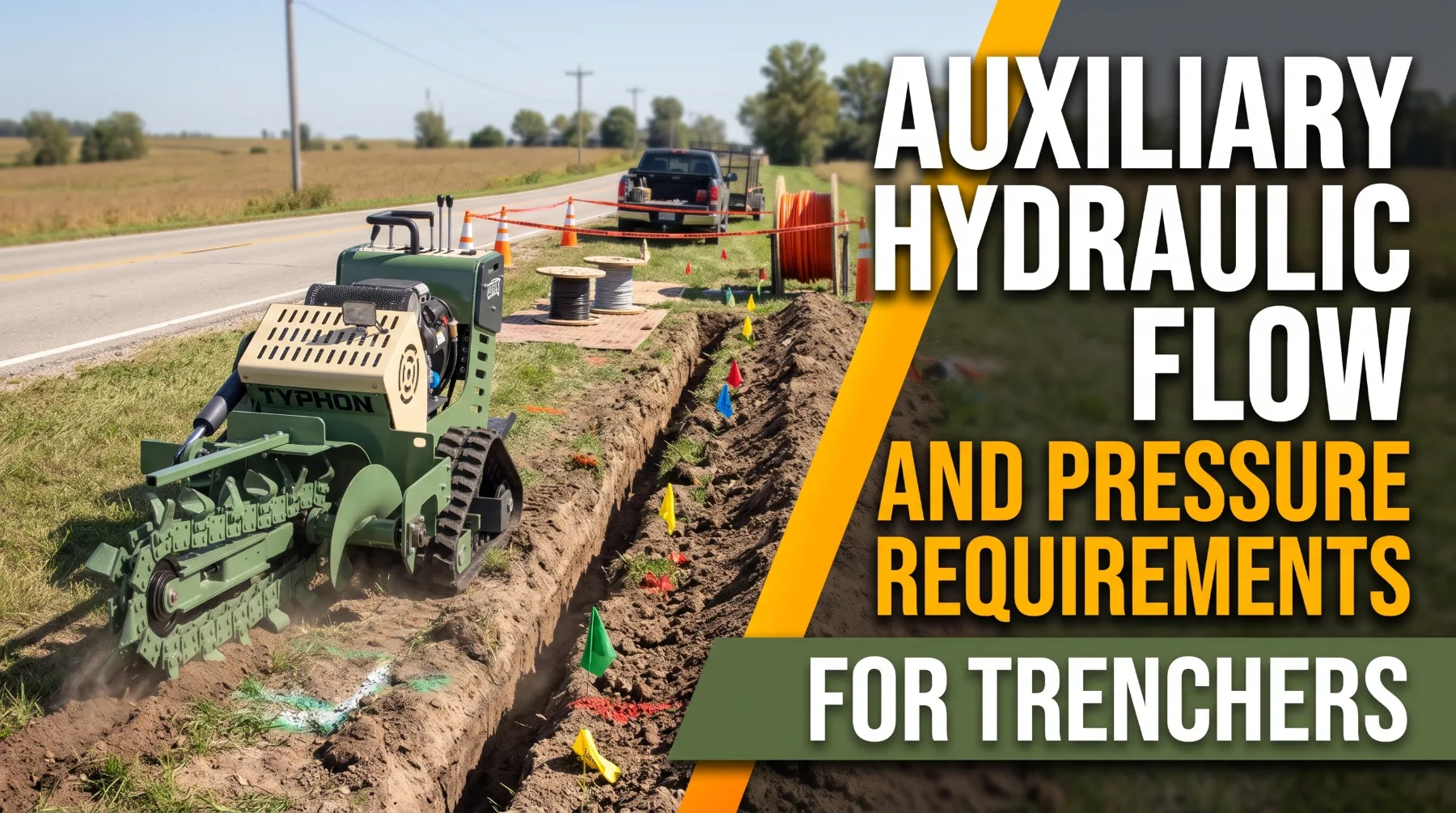
Underground utility, irrigation, drainage, and landscaping projects often require narrow, consistent trenches through different soil conditions. Hydraulic trenchers provide an efficient way to cut these channels using a rotating chain or cutting wheel, while moving excavated material away from the trench. Their performance depends on the compatibility between the attachment and the carrier machine's auxiliary hydraulic system.
Hydraulic flow and pressure influence different aspects of trencher operation. Flow rate affects cutting chain or wheel speed, while hydraulic pressure determines the torque available to overcome resistance from compacted soil and other materials. Return line configuration, coupler compatibility, soil hardness, and hydraulic oil temperature also affect performance and operating efficiency. For more information about available hydraulic trenchers, contractors can review different equipment options.
Proper equipment selection starts with comparing the carrier's auxiliary flow and pressure ratings against the trencher manufacturer's approved operating range. Operators should also confirm return line requirements, hose connections, and attachment compatibility before starting work. Monitoring hydraulic temperature, adjusting travel speed to soil conditions, and following manufacturer instructions help prevent overheating, component damage, and unnecessary downtime.
Hydraulic Flow and Cutting Chain Speed
Flow describes the volume of oil the carrier's auxiliary circuit delivers to the trencher, usually expressed in gallons per minute or liters per minute. That oil drives a hydraulic motor, which converts hydraulic energy into rotation. On a chain trencher, the motor turns the drive sprocket and moves the digging chain around the boom. On a wheel-type trencher, it turns the cutting wheel. More flow spins the motor faster, and less flow slows it down.
Chain speed directly affects how well a trencher cuts and clears spoil. At the intended speed, the teeth bite into the soil at an effective rate, and the chain carries loosened material up and out of the trench, where the spoil auger moves it aside. When flow falls below the attachment's approved range, the chain slows, the teeth take less material per pass, and spoil can fall back into the trench. Production drops, and the operator often responds by pushing harder or slowing travel speed to compensate.
Excessive flow causes a different set of problems. Sending more oil than the motor is designed to accept can overspeed it, raise oil temperature, strain seals, and shorten component life. A chain running faster than intended can also wear teeth and sprockets more quickly and throw spoil farther than expected. Higher flow doesn't automatically mean better trenching. The goal is flow that sits within the range the trencher manufacturer approves.
Published flow figures describe performance under specified conditions, often at full engine speed. Actual flow at the couplers can be lower because of pump wear, engine speed, oil temperature, or restrictions in fittings and hoses. For that reason, operators should run the carrier at the engine speed the manual recommends for attachment work. When performance is in doubt, a qualified technician can measure real flow with a calibrated flow meter at the manufacturer's test points.
Some trenchers include flow control valves or are offered in different motor configurations for standard-flow and high-flow carriers. Some carriers also allow auxiliary flow to be adjusted through a display or control setting. Confirm which configuration the attachment uses before purchase or rental, and record the correct flow setting for each attachment in the fleet so operators set it the same way every time.
Key takeaway: Flow controls chain or wheel speed, so confirm that the carrier's actual auxiliary flow falls within the trencher's approved range, run the engine at the recommended speed, and measure flow when performance seems off.
Pressure and Available Cutting Torque
Pressure is the force behind the oil, and it contributes directly to the torque the trencher's motor can produce. When the chain meets compacted clay, roots, or gravel, resistance rises. The hydraulic system responds by building pressure to keep the motor turning. As long as pressure stays below the system's relief setting, the motor keeps cutting. Once pressure reaches that limit, the relief valve opens, and the chain slows or stalls.
Soil resistance, cutting depth, chain condition, and tooth design all affect how much torque a trench requires. A deeper cut places more teeth in contact with the soil at once. Dull or worn teeth need more force to penetrate. Hard, rocky, or root-filled ground resists the chain far more than loose, sandy soil. Each of these factors pushes pressure upward and brings the system closer to its relief limit.
Every trencher lists a maximum operating pressure, and the carrier's auxiliary relief setting must stay within that limit. Relief valves protect hoses, couplers, motors, and the carrier's pump from damage. Raising a relief setting to push through difficult ground can overload components, rupture hoses, damage the motor, and release high-pressure oil with little warning. Relief adjustments belong only to qualified technicians working to the manufacturer's specifications.
Holding the chain in a stalled condition is equally harmful. When the motor stalls and the operator keeps the control engaged, oil passes over the relief valve continuously. That process converts engine power into heat without moving any soil. Within minutes, oil temperature can climb sharply. When the chain stalls, ease off the control, back the boom up slightly, reduce travel speed, and let the chain recover before continuing.
Flow and pressure work together, but they can't substitute for each other. Extra flow won't overcome a torque shortfall in hard ground, and extra pressure won't speed up a chain that lacks flow. Compatibility means both specifications fit the attachment's approved range. When the job consistently demands more torque than the setup can provide, the answer is a different trencher, chain, or method rather than a higher relief setting.
Key takeaway: Pressure supplies the torque that keeps the chain cutting in resistant ground, so keep relief settings within the trencher's rating, ease off when the chain stalls, and never raise pressure to force through unsuitable conditions.
Carrier Auxiliary Circuit Compatibility
Every carrier machine offers a specific auxiliary hydraulic output, and the trencher has to match it. Before buying or renting, compare four details: rated auxiliary flow, rated pressure, coupler type and size, and return-line or case-drain requirements. Each specification appears in the carrier's operator's manual or specification sheet and in the trencher manufacturer's documentation. Matching only one or two of these details isn't enough.
Skid steers and compact track loaders are commonly offered with standard-flow auxiliary hydraulics, and many models are available with an optional high-flow system. Labels alone can mislead. One manufacturer's high-flow output may differ substantially from another's, and a machine described as high-flow doesn't automatically match every high-flow trencher. Compare the actual flow and pressure figures for both machines rather than relying on the category name.
Coupler arrangements need careful attention too. High-flow systems often use larger couplers to carry the extra oil, while standard-flow circuits use smaller ones. Some carriers place high-flow and standard-flow couplers side by side. Connecting a trencher to the wrong set of couplers can deliver the wrong flow and may damage the attachment. Never use adapters to force an incompatible connection, and never improvise fittings that lack a clear pressure rating.
Electrical connections may also matter. Some trenchers use electrical controls, solenoid valves, or attachment control harnesses that connect to the carrier's attachment control plug. Others rely entirely on the carrier's auxiliary control. Check whether the trencher needs an electrical connection, and confirm that the carrier's harness and control system support it.
Used machines and mixed fleets deserve extra caution. Previous owners may have changed couplers, added or removed case-drain plumbing, or adjusted auxiliary settings. When in doubt, ask an authorized dealer to confirm the carrier's configuration by model and serial number, and have a qualified technician verify that the circuit matches the trencher's requirements before the first job.
Key takeaway: Compare rated flow, pressure, couplers, return lines, and electrical connections for both the carrier and the trencher, and never assume that a high-flow label or a fitting that connects guarantees compatibility.
Return Lines and Case Drain Requirements

Oil that drives the trencher's motor has to return to the carrier's tank, and the path it takes matters. The main return line carries oil back after it has done its work. Many trencher motors need that return path to have low restriction. When return oil faces too much resistance, back pressure builds in the motor, reducing available torque, adding heat, and stressing internal components.
Some hydraulic motors also require a separate case-drain line. All hydraulic motors allow a small amount of internal leakage, which lubricates and cools their internal parts. That leakage collects inside the motor housing, or case. A case-drain line carries it back to the tank at very low pressure. Without that path, pressure inside the case can rise high enough to blow out the motor's shaft seal, as the fiber-optic crew discovered.
Connecting the case drain correctly is essential. Case-drain lines are usually smaller than the main pressure and return lines and typically use their own dedicated coupler on both the attachment and the carrier. The case drain must connect to the carrier's designated case-drain port, never to a pressure line. Always connect the case drain first and disconnect it last, unless the manufacturer's instructions state otherwise, so the motor case is never left without a drain path while the main lines are pressurized.
Carriers without a factory case-drain port need careful evaluation before running a trencher that requires one. Some manufacturers offer approved case-drain kits, while other carriers simply aren't suited to that attachment. Never cap a case-drain line, connect it to the main return as a shortcut, or operate the trencher with the case drain disconnected. Follow the trencher manufacturer's connection diagram exactly and verify every line before startup.
Clean connections protect the motor and the carrier's entire hydraulic system. Wipe both halves of each coupler clean before connecting them, and install dust caps and plugs as soon as lines are disconnected. Before connecting or disconnecting any hydraulic line, lower the trencher boom to the ground, shut down the engine, and relieve auxiliary pressure as the manual directs. Store the trencher with its hoses capped and off the ground.
Key takeaway: Many trencher motors need a low-restriction return and a separate case-drain line, so follow the connection diagram exactly, connect the case drain to its designated port, and never run the trencher with that line capped or disconnected.
Soil Resistance and Operating Demand
Ground conditions have a major influence on how hard the trencher and carrier have to work. Loose, sandy soil cuts easily and clears quickly. Compacted clay, hardpan, frozen ground, dense roots, and rocky material all raise resistance, pushing hydraulic pressure up and increasing heat. Operating demand can change several times along a single trench, especially on sites with fill, old roadbeds, or buried debris.
Operators control that demand through travel speed, cutting depth, and work sequence. Slowing the carrier's travel speed gives the chain more time to clear material and reduces the load on the motor. In very hard ground, cutting a shallower first pass and returning for a second pass can be more efficient than forcing full depth at once. The trencher manufacturer's operating instructions describe recommended techniques for different conditions, and following them protects both machines.
Chain and tooth selection should match the ground. Cup teeth generally suit softer soils, while shark teeth and carbide-tipped teeth are designed for harder or more abrasive conditions. Worn, broken, or missing teeth increase resistance and heat while reducing production. Check chain tension as the manual directs, since a loose chain can jump the sprocket and an overtightened chain adds drag. Replace worn teeth and sprockets promptly.
Some ground isn't suited to a carrier-mounted trencher at all. Solid rock, large boulders, and heavy concrete debris can exceed what the attachment is designed to cut. Forcing the machine through unsuitable material creates unnecessary hydraulic heat, accelerates mechanical wear, and risks broken chains or damaged motors. In those conditions, consider a rock trencher, a breaker, an excavator, or another method better matched to the material.
Safe practices apply long before the chain touches the ground. Contact the local one-call utility locating service, wait for all lines to be marked, and expose marked utilities by approved hand-digging or vacuum excavation methods within the tolerance zone. Keep everyone well clear of the digging chain and spoil auger, and never step over or reach near a moving chain. Wear the seat belt and keep the seat bar or operator restraint lowered whenever the carrier is running. Where workers must enter a trench, follow OSHA excavation requirements for protective systems, competent person inspections, and safe access.
Key takeaway: Hard, compacted, rooted, or rocky ground raises hydraulic demand, so adjust travel speed and cutting depth, match teeth to the soil, maintain chain tension, and switch methods when the material exceeds the trencher's capability.
Hydraulic Temperature and System Maintenance
Continuous trencher operation generates steady heat in the carrier's hydraulic system. Unlike a bucket, which works in short bursts, a trencher can run its motor at high demand for long periods. Every time oil passes over a relief valve, faces back pressure, or drives a motor against heavy resistance, some energy becomes heat. Over a full day, that heat can build faster than the system can shed it.

Excess heat damages hydraulic systems from the inside. As oil temperature rises, the oil thins and loses some of its ability to lubricate and seal. Seals harden and wear faster, internal leakage increases, and components lose efficiency. Many carriers display a hydraulic temperature gauge or warning light. When temperature climbs above normal, stop trenching, let the machine idle as the manual directs or shut it down, and investigate the cause before continuing.
Cooling depends on clean airflow through the carrier's oil cooler and radiator. Trenching often happens in dusty, grassy, or debris-filled areas, and coolers can clog quickly. Inspect cooler fins and screens before every shift and clean them as the manual directs, more often in dusty conditions. Check hydraulic oil level with the attachment lowered and the machine on level ground. Replace hydraulic filters and oil at the manufacturer's intervals, and use only the specified oil type.
Key takeaway: Long trenching runs build hydraulic heat, so keep coolers clean, watch temperature gauges, inspect hoses and the case drain every shift, check leaks with cardboard rather than your hands, and complete a full lockout before any service.
Conclusion
Trencher compatibility depends on matching the carrier's auxiliary hydraulics to the attachment's requirements in every detail. Flow sets chain or wheel speed, and pressure supplies the torque that keeps teeth cutting through resistant soil. Return lines must carry oil back without excess restriction, and motors that require a case drain need that line connected correctly every time. Couplers, electrical connections, and the carrier's real output complete the picture. When any one of these details is mismatched, even a well-built trencher can run slowly, overheat, or damage its seals.
Contractors who verify these specifications before the job protect their equipment, their schedules, and their crews. Compare flow, pressure, couplers, and return plumbing for both machines, and have actual flow measured when results seem off. Match travel speed, cutting depth, and teeth to the ground, and change methods when the material exceeds the attachment's capability. Keep coolers clean, inspect hoses and connections daily, check leaks with cardboard, and lock out the machine before every service task. That disciplined approach delivers consistent trenching performance and long, dependable service from both carrier and attachment.
Frequently Asked Questions
What does hydraulic flow control on a trencher?
Flow primarily controls the speed of the hydraulic motor, which drives the cutting chain or wheel. Too little flow slows the chain and reduces production, while too much flow can overspeed the motor and create excess heat. The carrier's actual flow should fall within the trencher's approved range.
What does hydraulic pressure contribute?
Pressure contributes to the torque the motor produces, which keeps the chain cutting as soil resistance rises. The carrier's relief setting must stay within the trencher's maximum rated pressure. Raising relief settings to force through hard ground can damage hoses, couplers, and the motor.
Can a standard-flow carrier operate every trencher?
No. Each trencher has its own approved flow and pressure range, and some are built specifically for high-flow carriers. Compare the actual flow and pressure figures, coupler types, and return-line requirements for both machines rather than relying on general labels.
Why might a trencher need a case drain?
Some hydraulic motors collect internal leakage oil inside their housing. A case-drain line returns that oil to the tank at very low pressure. Without it, pressure can build inside the motor case and blow out the shaft seal, so the line must always be connected to the carrier's designated case-drain port.
groundripper.com Featured Equipment
Looking for top-performing heavy equipment, authentic attachments, and dependable jobsite power? Explore verified models backed by manufacturer warranty and nationwide delivery.
View Specifications & Pricing →
COMMENTS (0)
LEAVE A REPLY