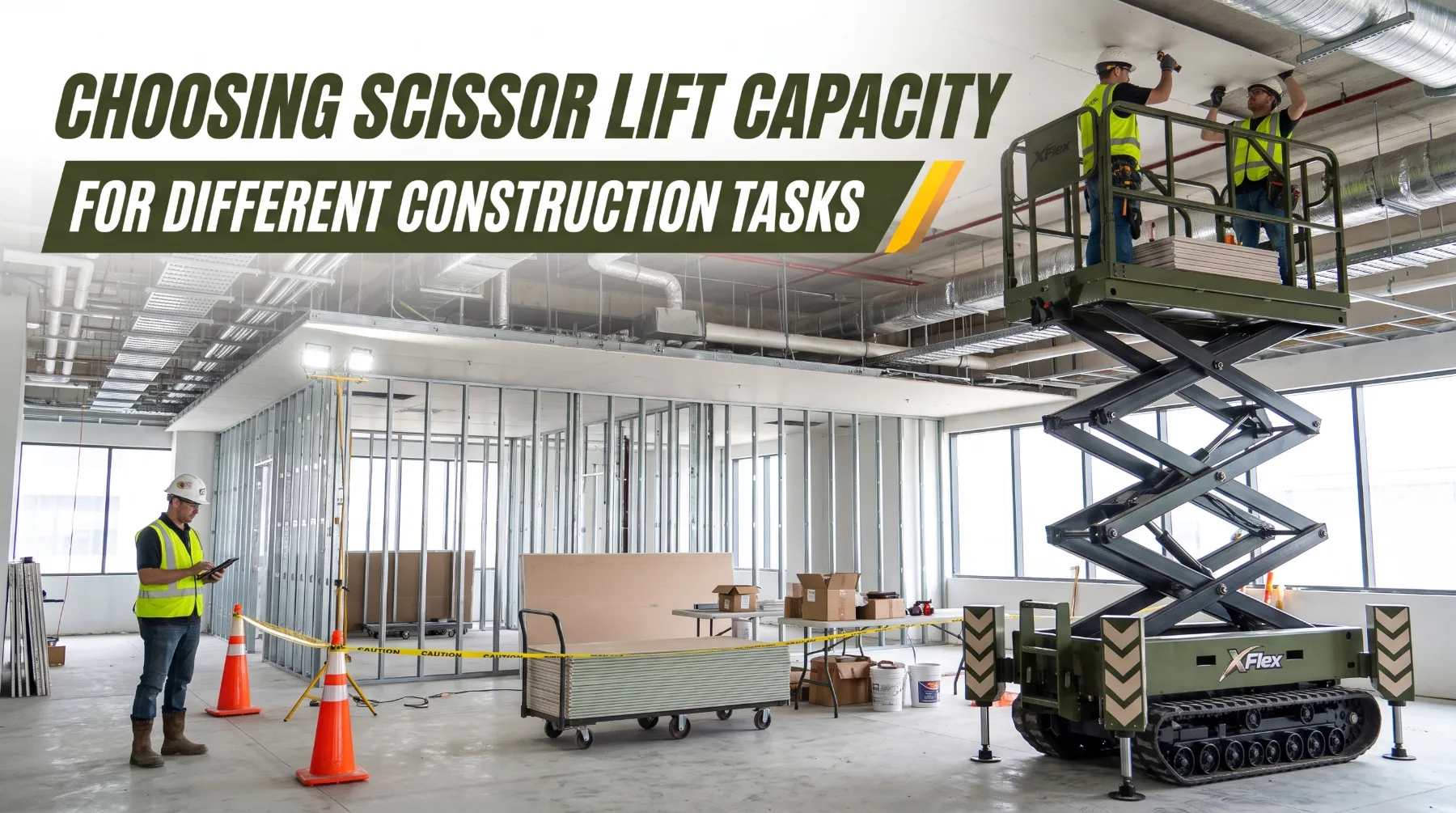
Scissor lifts are some of the most widely used machines on construction sites. Electricians use them to run conduit and hang fixtures. Drywall and ceiling crews install grid, tile, and board overhead. Mechanical contractors set hangers and duct runs, and finish trades paint, patch, and seal at height. These jobs look different from the ground, but every one of them puts weight on the same platform. That platform has a firm limit on how much it can safely carry.
Rated platform capacity is the maximum combined weight a scissor lift is designed to support during elevated work. It covers every worker, tool, fastener, material, and piece of packaging on the deck. Many contractors choose a lift by working height and platform size, assuming capacity will take care of itself. That assumption often holds up on light tasks. It fails when two installers bring heavy tool bags, a box of fixtures, and a stack of board onto a compact slab scissor. It also fails when an outdoor job reduces the occupant limit, or when a crew loads materials onto an extension deck rated for only a fraction of the main platform's capacity.
Exceeding capacity is not a minor overstep. It reduces the stability margin, puts strain on the scissor arms, pins, and lift cylinder, and can trigger overload protection in the middle of a task. In serious cases, it contributes to tip-overs and structural failures that put everyone on and around the machine at risk. Choosing the right capacity from the start protects the crew, keeps work moving, and prevents the delays that come from swapping machines partway through a project.
Selecting Capacity for One or Multiple Workers
Some construction tasks need only one operator. A technician replacing sensors, an inspector checking ceiling connections, or a painter touching up trim can often work alone with a light tool kit. Other jobs depend on two or more workers. Hanging long runs of cable tray, installing heavy light fixtures, setting ceiling panels, or fitting overhead equipment usually goes faster and more safely with one person holding while another fastens. The number of workers is one of the biggest factors in choosing capacity.
Every scissor lift carries two limits that must be respected together: a rated capacity and a maximum number of occupants. A platform rated for 1,000 pounds and two occupants cannot carry three people, even if their combined weight is well below 1,000 pounds. The occupant limit reflects stability, guardrail design, emergency procedures, and the way people move and shift weight on the deck. It is not just a weight calculation. Likewise, two workers who are within the occupant limit can still exceed capacity once their tools and materials are added.
Platform space can be misleading. A wide deck with extension may look like it has room for several workers, but the physical space doesn't change the approved occupant limit. Crews should never add a person simply because there's room to stand. If a task needs more hands than one lift allows, use a second machine, choose a model approved for more occupants, or adjust the work method so materials are staged and handed up safely between lifts.
Also consider how workers move during the task. Two people on a platform will shift positions, lean into work, and push against overhead structures while drilling or fastening. Many lifts carry a rated limit on horizontal or manual force, which restricts how much side load workers can apply against structures. Heavy drilling into concrete ceilings or pulling on stubborn components can approach those limits. Follow the manufacturer's guidance, keep both feet on the platform floor, and never lean beyond the guardrails to reach.
Key takeaway: Respect both the rated capacity and the maximum occupant limit at the same time, choose a machine that fits the crew size the task really needs, and never add workers just because the platform has space.
Matching Platform Capacity to Building Materials
The materials a task requires often decide which lift is suitable. Light electrical components, such as sensors, small fixtures, and boxes of connectors, add little weight and suit compact slab scissors well. Ceiling panels, metal studs and track, gypsum board, glazing units, ductwork sections, sprinkler pipe, and mechanical equipment can add hundreds of pounds quickly. A lift that's ideal for a lighting retrofit may be completely unsuitable for overhead board installation in the same building.
Calculate material weight item by item using manufacturer data or actual weights rather than rough estimates. Then consider how the materials will be carried and handled. Long items such as conduit, studs, pipe, and board can overhang the platform or press against guardrails, which creates concentrated loads and side forces the platform wasn't designed for. Many manufacturers prohibit loads that extend beyond the guardrails unless an approved accessory, such as a pipe rack or panel carrier, is fitted. These accessories carry their own weight and capacity limits, and they often reduce the rated capacity of the main platform.
Carrying materials sensibly protects both safety and productivity. Bring up only what the current section of work requires instead of loading a full day's supply. For a crew installing ceiling grid, that may mean carrying enough main runners and cross tees for one bay, then resupplying from a staged cart at ground level. Send empty cartons and offcuts down at planned intervals so they don't build up and add hidden weight. Use secured containers and tool trays so items can't fall, and establish a protected zone below the platform to keep people clear of dropped objects.
A scissor lift is a personnel platform, not a material hoist or crane. It shouldn't be used to lift heavy loads that exceed its rating or to raise materials that require rigging. When a task involves large or heavy components, such as rooftop equipment, large glazing panels, or heavy mechanical units, plan for the right material handling equipment instead of overloading a lift.
Key takeaway: Calculate material weights accurately, carry only what each section of work needs, use approved accessories for long or awkward items, and choose dedicated material handling equipment when loads exceed what a personnel platform should carry.
Platform Dimensions and Load Distribution
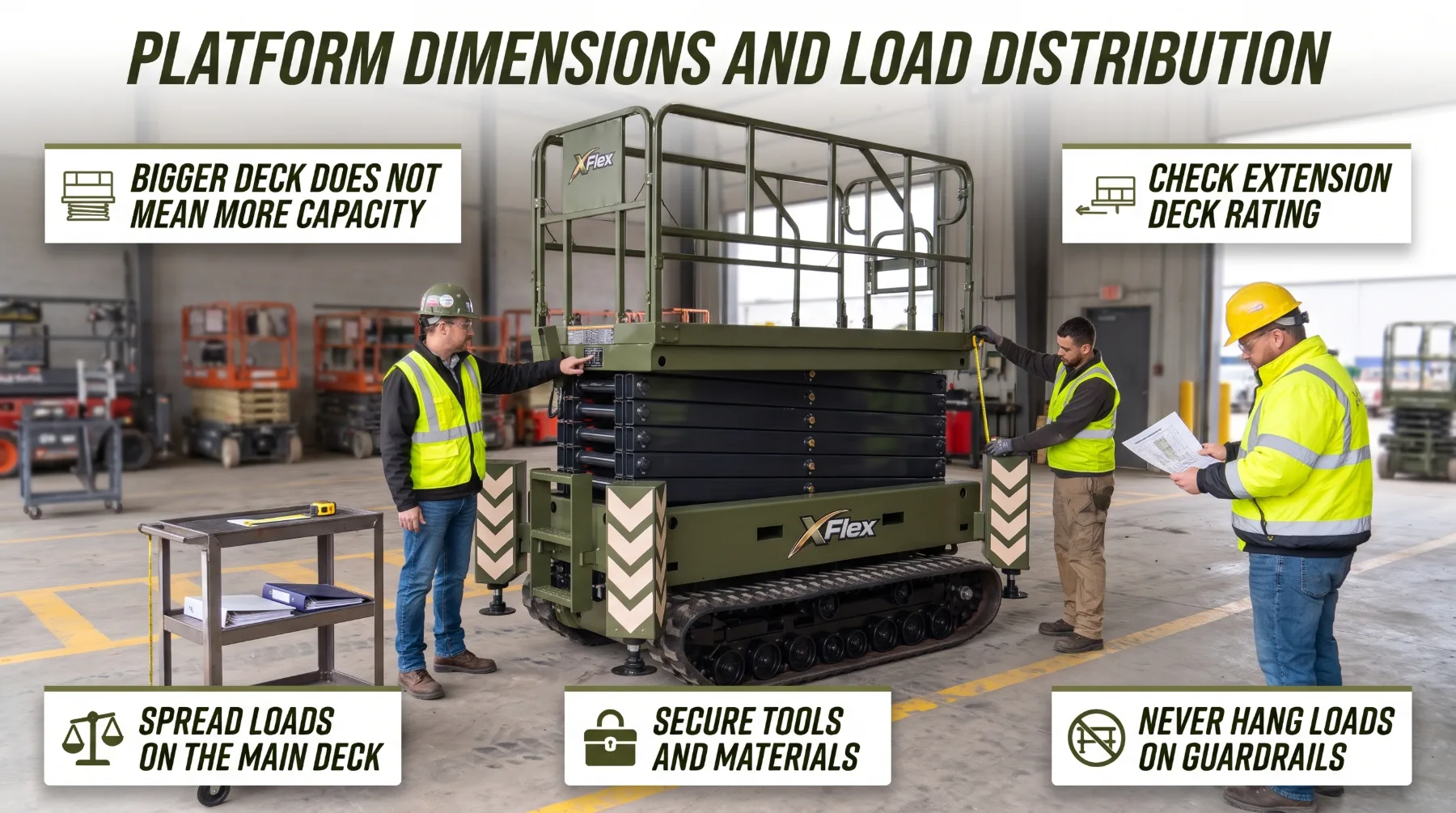
Platform dimensions determine how workers and materials can be arranged, but they don't increase capacity. A larger deck makes it easier to organize tools, keep walkways clear, and position workers comfortably beneath the work. The total weight must still stay within the rated limit, regardless of how much space is available. A spacious platform loaded with heavy materials can be overloaded just as easily as a small one.
How weight is distributed matters as much as how much there is. Manufacturers design platforms to support loads distributed according to their instructions, usually spread across the main deck rather than concentrated at one point. Stacking all materials at one end, piling heavy items against a guardrail, or placing a concentrated load near the platform edge can create stresses the structure wasn't designed to handle. It can also shift the machine's center of gravity, especially when the platform is fully raised.
Extension decks deserve particular attention. Most scissor lifts include a roll-out or slide-out extension that brings workers closer to the task. That extension usually has its own capacity rating, often only a few hundred pounds, which is far lower than the main platform. Placing heavy materials or two workers on an extended deck can exceed that limit even when the total platform load is acceptable. Check the data plate for the extension rating, keep heavy items on the main deck, and use the extension only for what it is approved to carry.
Guardrails are fall protection, not storage. Never hang materials, buckets, cords, or tool bags from guardrails, and never rest heavy items on them, unless the manufacturer approves a specific accessory for that purpose. Keep the deck floor organized so workers have clear footing, close the entry gate before raising, and secure loose items so they can't shift during movement.
Key takeaway: A larger platform improves organization but not capacity, so distribute loads according to the manufacturer's instructions, respect the separate extension deck rating, and keep heavy items off guardrails and platform edges.
Indoor and Outdoor Capacity Considerations
Many scissor lifts carry different ratings depending on whether they are used indoors or outdoors. The main reason is wind. Wind pushes against the platform, the workers, and any materials, adding a side load that reduces the stability margin, particularly at full height. A lift that is perfectly stable indoors may need a lower capacity, fewer occupants, or both to stay within its design limits outside.
Many compact slab scissors are rated for indoor use only, which means zero wind, and they must never be raised outdoors. Outdoor-rated models usually list a maximum wind speed, commonly around 28 mph (12.5 m/s), and may reduce the permitted occupants. A lift approved for two people indoors may allow only one person outdoors. Some machines also reduce rated capacity in outdoor configuration. Check the data plate and operator's manual for the exact model, and never assume that an indoor rating applies outdoors.
Wind conditions at platform height can be stronger than at ground level, and buildings often channel gusts through gaps and around corners. Large flat materials, such as plywood, insulation boards, or panels, act like sails and increase wind load significantly. Even within the rated wind speed, carrying sheet materials outdoors calls for extra caution and may be prohibited by the manufacturer.
Ground conditions also change outdoors. Slab scissors are designed for firm, level, hard surfaces, while rough-terrain scissor lifts are built for prepared outdoor ground and often carry higher capacities and larger platforms. Even rough-terrain models have slope limits, ground-pressure considerations, and, on some units, outriggers or leveling systems that must be set according to the manual. Rain, soft soil, and backfill can reduce ground support quickly, so reassess conditions whenever the weather changes.
Key takeaway: Indoor and outdoor ratings can differ in capacity, occupants, and wind limits, so check the data plate for the exact configuration, never raise indoor-only machines outside, and treat wind and ground conditions as part of every outdoor capacity decision.
Evaluating Capacity Alongside Height and Access
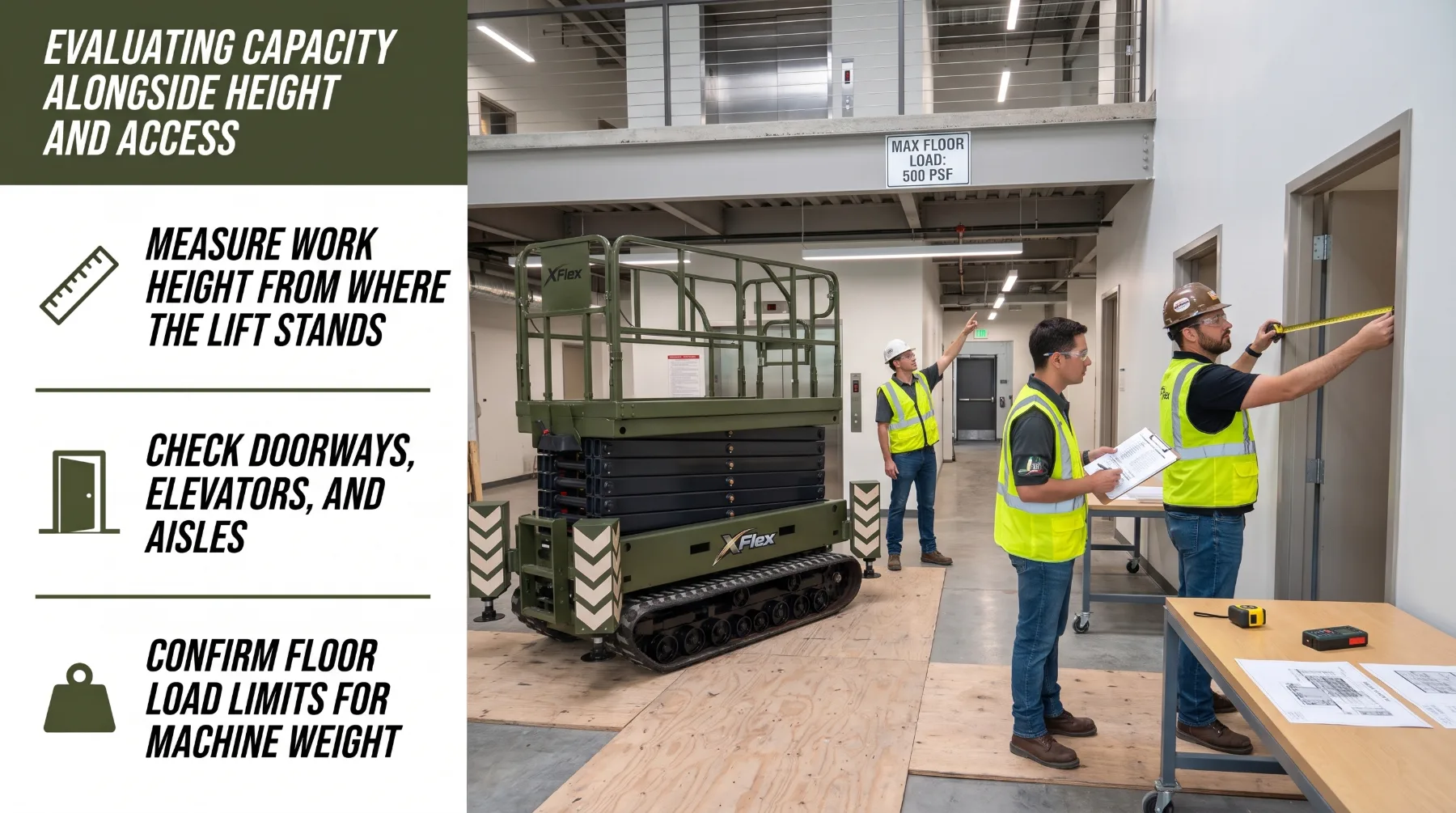
Capacity is only one part of choosing the right scissor lift. The machine must also reach the work comfortably, fit through the site's entrances, maneuver in the available space, and stand on a surface that can support it. A lift with plenty of capacity but the wrong dimensions can block a project as effectively as one that's too small.
Start with height. Measure the work from where the lift will stand and confirm whether the specification lists platform height or working height. Choose a machine that lets workers perform the task from the platform floor without stretching over guardrails. Then check access. Narrow slab scissors, often around 30 to 32 inches wide, pass through standard doorways and fit in tight corridors but usually offer smaller platforms and lower capacities. Wider models, commonly around 46 to 48 inches, provide more deck space and higher capacity but may not fit through single doors or between racking. Measure doorways, elevator cabs, aisles, ramps, and turning areas along the route, and compare them with the machine's stowed width, length, height, and turning radius.
Higher-capacity lifts are generally heavier machines, which affects the surfaces they can travel on. Suspended slabs, mezzanines, raised access floors, and elevated decks have load ratings, and a heavy scissor lift concentrates its weight through small tire contact areas. Manufacturers often publish machine weight, maximum wheel load, or ground-bearing pressure for this purpose. Confirm with the building engineer or project team that the floor can support the chosen machine before moving it into place, and use load-spreading floor protection where approved.
Balance all of these factors together. For a lighting retrofit in an occupied office, a narrow lift with modest capacity may be the best choice. For a two-person drywall crew in an open warehouse shell, a wider, higher-capacity model will be more productive. For exterior soffit work on a graded site, an outdoor-rated rough-terrain lift may be required. Discuss the full task with your equipment supplier, including workers, materials, height, access, and floor conditions, so the recommended machine fits the work.
Key takeaway: Select a lift that combines adequate capacity with the right working height, dimensions, maneuverability, and floor loading, and share the complete task details with your supplier before choosing a machine.
Conclusion
Choosing scissor lift capacity takes more than reading the largest number on a specification sheet. It starts with an accurate count of every worker in full gear, every tool, every material, and all packaging, compared against the rated capacity with a sensible margin. The occupant limit must be respected alongside weight, and materials should be carried in manageable quantities with approved accessories for long or awkward items. Platform size improves organization but doesn't increase capacity, and extension decks often carry much lower ratings. Outdoor use can reduce capacity and occupants because of wind, while access routes, doorway widths, and floor load limits determine whether a capable machine can actually reach the work.
Frequently Asked Questions
How is scissor lift capacity calculated?
Add the weight of every worker in full work gear, every tool and battery, all materials, and any packaging that will be on the platform. Compare that total with the rated capacity on the machine's data plate, and confirm that the number of people stays within the occupant limit. Use actual weights for materials where possible, and leave a practical margin, since loads change during a shift as materials arrive and offcuts accumulate. Check separate limits for extension decks and accessories as well.
Does a larger platform always have a higher capacity?
No. Platform size and rated capacity are separate specifications. A larger deck makes it easier to arrange workers and materials, but it doesn't allow more weight than the data plate permits. Some large platforms have modest capacities, and extension decks usually carry much lower ratings than the main platform. Always choose a lift based on the calculated load and occupant count rather than on how much space the deck appears to offer.
Can a scissor lift carry construction materials?
Yes, when the total load and its distribution stay within the manufacturer's approved limits. Carry only the materials needed for the current section of work, distribute them across the main deck, and secure loose items so they can't fall. Long items that overhang the guardrails may be prohibited unless an approved accessory is fitted. A scissor lift is a personnel platform, so heavy or bulky components that exceed its rating should be handled with dedicated material handling equipment.
Should indoor and outdoor capacity ratings be checked separately?
Yes. Many scissor lifts list different capacities, occupant limits, and wind ratings for indoor and outdoor use, and some are approved for indoor use only. Wind adds side load that reduces stability, so outdoor ratings are often lower. Check the data plate and operator's manual for the exact model and configuration, never raise an indoor-only machine outdoors, and take extra care with large flat materials that catch wind.
COMMENTS (0)
LEAVE A REPLY