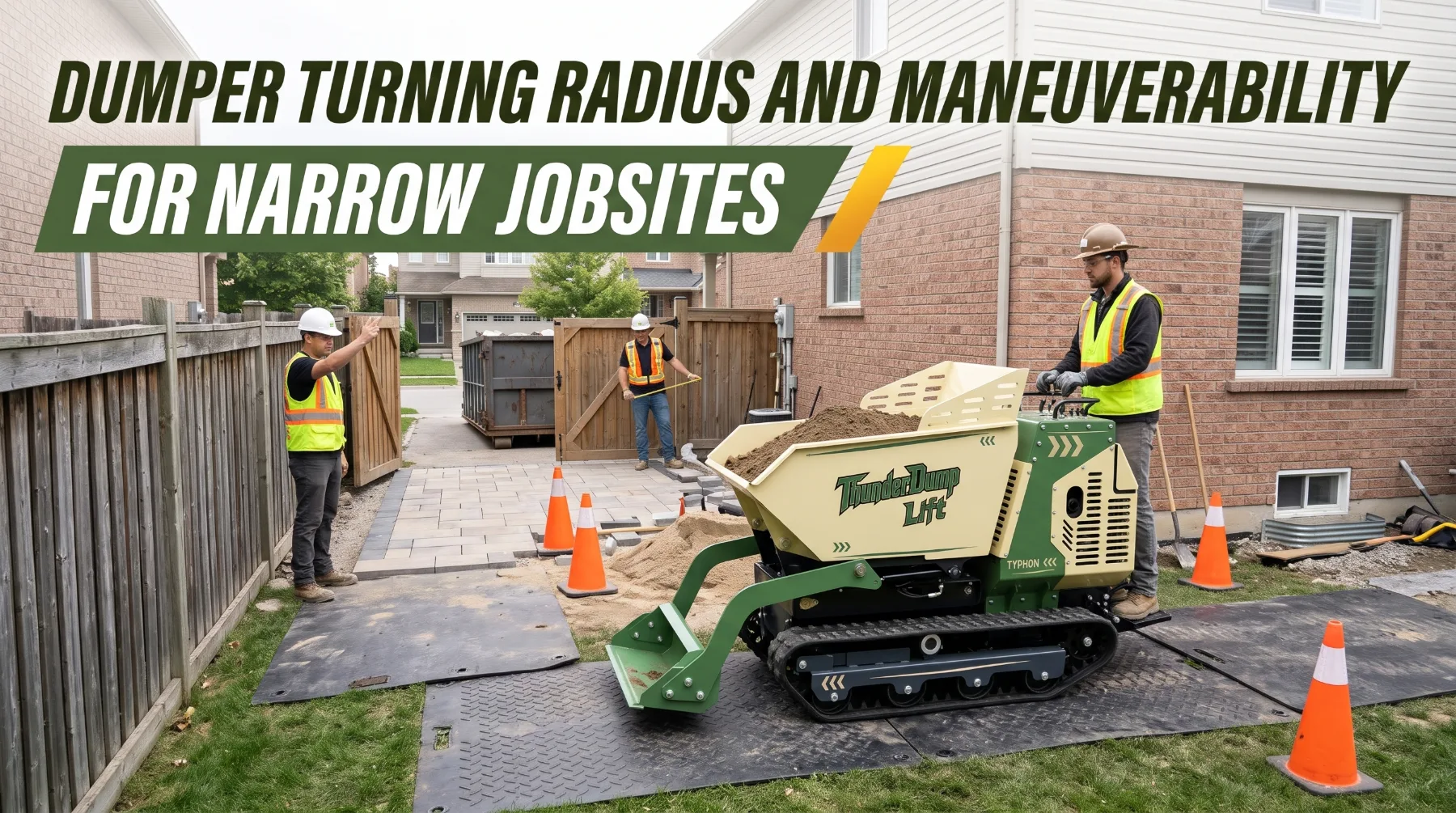
Dumper Turning Radius and Maneuverability for Narrow Jobsites

Compact dumpers are widely used in residential construction, landscaping, demolition, and other projects where working space and site access are limited. Their compact dimensions and maneuverability allow them to transport materials through narrow passages, around obstacles, and across restricted work areas. However, maneuverability depends on more than overall machine size.
Turning radius, machine dimensions, steering design, load distribution, and handling characteristics all affect how easily a dumper moves through confined routes, positions near loading areas, and unloads materials. Understanding these specifications helps operators and equipment buyers select suitable machines, plan efficient travel routes, and maintain safe operation across different jobsites. This article explains the key factors that influence compact dumper maneuverability and how to evaluate them for practical applications.
Understand Turning Radius
Turning radius describes the space a machine needs to complete a turn. It is one of the most useful figures for comparing maneuverability, but only when you know exactly what each manufacturer is measuring. Two dumpers with similar-looking figures can need very different amounts of space on site.
Manufacturers may list an inside turning radius, an outside turning radius, or an overall turning radius. The inside radius measures the tightest arc traced by the innermost point of the machine. The outside radius measures the widest arc, usually traced by the outer corner of the bed, frame, or tire. Some specifications also list a turning circle or diameter, which is roughly twice the radius. Another common distinction is between curb-to-curb measurements, which track the tires or tracks, and wall-to-wall measurements, which include the body, bed, and anything else that overhangs the running gear. On a narrow jobsite, the wall-to-wall figure usually tells you more, because the bed corner or rollover protective structure is often what strikes a fence or wall.
Consistent definitions are essential when comparing models. Before you rely on a published figure, ask each manufacturer which measurement it represents, whether it was taken with the machine loaded or empty, and on what surface. Convert all figures to the same basis, such as outside wall-to-wall radius, before lining up machines side by side. Then compare that figure with the tightest corners on your typical routes, leaving practical clearance for operator error, uneven ground, and the need to adjust mid-turn.
Key takeaway: Confirm whether each turning radius figure is inside, outside, or overall, and whether it measures tires or the full machine body. Compare models only on the same basis.
Compare Machine Width and Length

A small turning radius doesn't guarantee access through every narrow route. Overall width decides whether the machine fits through a gate or doorway in the first place. Overall length, bed dimensions, and operator position decide whether it can clear corners, turn in confined spaces, and position close to the loading and discharge points.
Start with width. Measure the narrowest openings along your typical routes, including side gates, spaces between houses, doorways on interior demolition work, and paths between landscaping features. Compare those measurements with the dumper's overall width at its widest point, which may be the bed, the tracks, the frame, or the rollover protective structure. Some compact tracked dumpers offer adjustable track width or folding components that reduce width for travel through tight openings. Confirm whether the machine can work safely at its narrowest setting or whether that setting is intended for travel only.
Length matters most at corners. A longer machine sweeps a wider path through a turn, even when its width is modest. Bed length and overhang beyond the tracks or wheels can swing into walls and fences. Operator position also affects clearance. A ride-on dumper with a seat at the rear, a stand-on platform, or a walk-behind configuration each changes the overall length and the space the operator needs around the machine. Walk-behind operators also need room to stand and move safely behind the dumper without being pinned against a structure.
Before selecting a dumper, walk your typical sites with a tape measure. Record gate widths, path widths, corner clearances, ceiling heights on interior work, and the turning space available at loading and unloading points. Compare those figures with each machine's documented dimensions, and choose a model that fits with sensible margin rather than only just squeezing through.
Key takeaway: Width decides whether the machine fits, while length and overhang decide whether it can turn. Measure gates, paths, corners, and working areas before you buy.
Review Steering Configuration
Steering design has a major effect on how a dumper changes direction and how much space it needs to maneuver. Different configurations suit different sites, and understanding the trade-offs helps you match the machine to your typical routes.
Many compact tracked dumpers use skid-steer-style steering, where the tracks on each side are driven at different speeds or in opposite directions. When the tracks counter-rotate, the machine can turn close to its own center, which makes it highly maneuverable in confined spaces. The trade-off is ground disturbance. Counter-rotation scuffs and tears turf, scrapes pavers, and can churn soft soil, especially with a loaded bed. Operators can reduce this by making gradual, wide turns where space allows and by using ground protection mats on sensitive surfaces.
Many wheeled site dumpers use articulated steering, where the machine pivots at a central joint between the front and rear sections. Articulated steering allows tight turns while keeping the wheels tracking along similar paths, which reduces ground scuffing compared with skid steering. However, the pivot shifts the machine's weight as it turns, and articulated dumpers are particularly sensitive to stability when turning on slopes or with a raised or heavily loaded bed. Some dumpers use other arrangements, such as front-wheel or rear-wheel steering, each with its own turning behavior. Rear-steer machines, for example, swing their back end outward during a turn, which needs extra clearance near walls.
Swivel-bed dumpers add another option. Rotating the bed to discharge sideways can remove the need to turn the whole machine at the unloading point. That doesn't change the turning radius, but it can reduce how often the machine needs to turn in tight spaces. When you evaluate a dumper, have your operators drive it through tight turns and reversing maneuvers on representative ground, and pay attention to how the steering responds and how the ground holds up.
Key takeaway: Skid-steer-style tracked dumpers turn in very tight spaces but disturb surfaces more, while articulated machines turn smoothly but require extra care with stability on slopes. Match steering design to your terrain and surfaces.
Consider Loaded and Unloaded Handling
A dumper that turns easily when empty may behave very differently with a full bed. Material weight changes the machine's center of gravity, increases momentum, and puts more load on tracks, tires, and steering components. Specifications measured with an empty machine don't always reflect how it handles on the return trip with a heavy load.
Material weight and distribution have the greatest effect. Dense materials such as wet soil, gravel, sand, and broken concrete can reach the rated payload long before the bed looks full. A load piled unevenly or shifted to one side makes the machine more likely to lean or tip during a turn. Load the bed evenly, keep material below the rim to prevent spills, and load by weight rather than by volume. Never exceed the rated payload to save a trip.
A loaded dumper also needs more distance to stop and more care through turns. Speed, steering input, and ground conditions combine to determine stability. A sharp turn at speed with a heavy load can shift weight to the outside of the turn and lift the inside track or wheel. On articulated machines, turning a loaded dumper on a slope or across a grade significantly increases the risk of rollover. Slow down before turning, make smooth steering inputs, and avoid turning on slopes whenever possible. Travel straight up and down grades, and follow the manufacturer's guidance on travel direction with a loaded bed.
Raised beds create the greatest stability risk. Never travel or turn with the bed raised, and lower it fully after every discharge. On ride-on dumpers, keep the rollover protective structure in its working position and always wear the seat belt. On walk-behind models, operators should stay clear of the machine's path and never position themselves where a turning or tipping dumper could pin them against a structure.
Key takeaway: A full load raises momentum and changes stability. Stay within rated payload, load evenly, slow down before turning, and never turn on a slope or with the bed raised.
Evaluate Ground Conditions
Even the most maneuverable dumper depends on the ground beneath it. Loose gravel, mud, wet clay, slopes, and uneven surfaces all affect traction and the machine's ability to turn precisely. A dumper that pivots cleanly on dry concrete may slide, dig in, or lose control on soft, wet ground.
Different surfaces create different problems. Loose gravel shifts under tracks and tires, which can cause the machine to slide wide through a turn. Mud and wet clay reduce grip and pack into tracks and tire treads, cutting traction further. Soft soil and lawns can rut or tear, particularly under counter-rotating tracks. Slopes and cross-slopes reduce stability and make steering less predictable, especially with a loaded bed. Steel plates over trenches, ramps, and transitions between surfaces can also cause sudden loss of grip.
Choose a running gear that suits your typical terrain. Rubber tracks spread weight over a larger area, which lowers ground pressure and improves grip on soft or wet ground. Wheeled dumpers often travel faster on firm, even surfaces, and four-wheel drive improves traction across varied conditions. Check tire pressure and tread condition, or track tension and wear, as part of every pre-shift inspection, since worn or poorly adjusted running gear reduces control. Keep tracks and undercarriages clear of packed mud.
Inspect the route before work begins and again after rain. Place ground protection mats on lawns and finished surfaces, fill or mark holes and soft spots, and keep the travel path clear of debris. Follow the manufacturer's operating limits for slopes and ground conditions, and stop to reassess whenever conditions change.
Key takeaway: Ground conditions decide how well a dumper turns in practice. Match tracks or wheels to your terrain, maintain the running gear, and inspect the route before and during work.
Plan Routes and Unloading Positions
Maneuverability on a narrow jobsite depends as much on planning as on the machine. A well-planned route reduces turning, reversing, and repositioning on every trip. That saves time, protects finished surfaces, and lowers the risk of collisions with structures and people.
Map the route from the loading area to the discharge point before work begins. Identify the narrowest points, the tightest corners, any slopes or cross-slopes, and surfaces that need protection. Remove obstacles such as stored materials, garden furniture, hoses, and debris. Where possible, create turning areas at each end of the route so the dumper can change direction on firm, level ground rather than reversing long distances. Plan the loading position so the excavator or loader can fill the bed without the dumper turning in a confined space.

The unloading location needs the same attention. Make sure it has stable, level ground and enough space for the bed to tip or swivel without striking walls, fences, or overhead obstructions. Check for overhead power lines, branches, and eaves before raising the bed, especially on high-tip machines. When discharging into a trench or over an edge, use properly placed stop blocks and keep the setback distance your site requires. Never rely on the operator to judge an edge by eye.
Coordinate people and machines along the route. Keep ground crews clear of the travel path and unloading area, agree on hand signals, and use a trained spotter where visibility is limited or the route passes close to structures or people. Brief every operator on the planned route, turning points, and discharge position at the start of each shift, and update the plan as the job progresses and conditions change.
Key takeaway: Map the route, clear obstacles, create safe turning areas, and confirm stable, unobstructed unloading positions before work begins. Good planning reduces turning and protects people and property.
Conclusion
A compact dumper’s maneuverability on narrow jobsites depends on turning radius, overall dimensions, steering design, load, and ground conditions. Turning radius figures must be understood in terms of how they were measured, while machine width and length determine whether it can pass through openings and negotiate tight corners. Steering configuration also affects handling and surface disturbance, especially on soft or sloped terrain. A loaded bed can further change how the machine behaves during turns. Assess your typical routes by measuring gates, paths, corners, and working areas, then compare those measurements with each dumper’s documented dimensions and turning specifications. Request written details on the measurement method and arrange a loaded demonstration on representative ground. This helps operators confirm that the machine can navigate actual site conditions safely and efficiently.
Frequently Asked Questions
What is a dumper turning radius?
It is the space required for the dumper to complete a turn, based on the manufacturer's stated measurement. Check whether the figure is inside, outside, or overall radius, and whether it measures the tires or tracks only or the full machine body.
Is a narrow dumper always easier to maneuver?
Not necessarily. A narrow machine fits through tighter openings, but length, overhang, steering design, turning radius, and ground conditions also decide how easily it turns and positions in confined spaces.
Does a full load affect turning?
Yes. Payload and load distribution change the center of gravity, increase momentum, and affect stability and stopping distance. Slow down before turning, load evenly, and never turn on a slope or with the bed raised.
What should be measured before buying a compact dumper?
Measure access width at gates and doorways, corner clearances, turning areas, route length, unloading space, overhead clearance, and the slope and condition of the surfaces along the route.
groundripper.com Featured Equipment
Looking for top-performing heavy equipment, authentic attachments, and dependable jobsite power? Explore verified models backed by manufacturer warranty and nationwide delivery.
View Specifications & Pricing →
COMMENTS (0)
LEAVE A REPLY